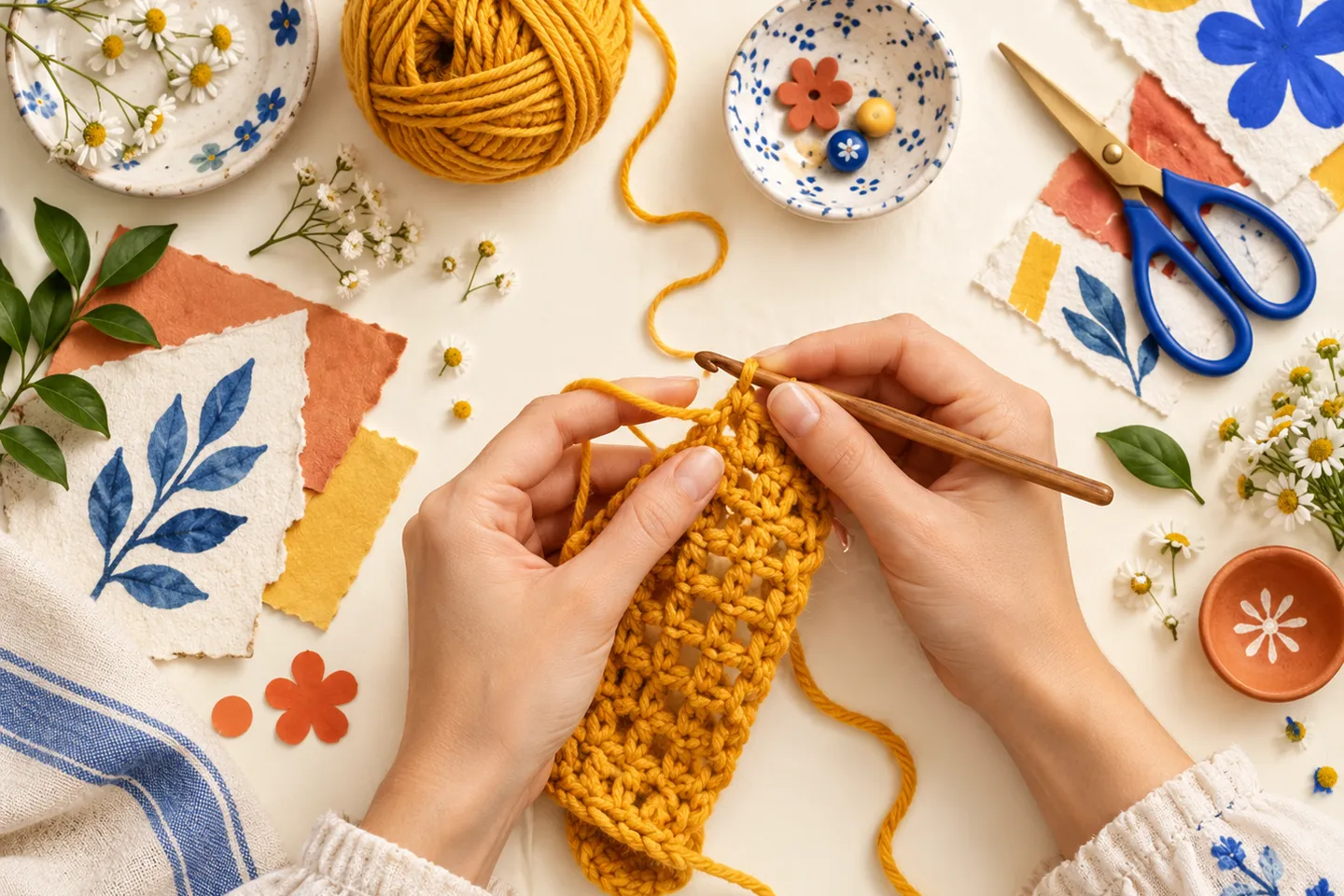
Most days, your hands know one dance. Type, tap, swipe, scroll. Repeat until bedtime.
They are very good at it. They can do it while you think about something else. That is the problem. Your hands have become a delivery system for your attention, and your attention is somewhere else. Usually on a screen. Usually on something that will not matter next week.
Making something changes the deal. Your hands get a real job again.
The body knows things the mind forgets
Loop yarn over a hook. Watch paint move across a wet page. Fold paper, turn it, fold it again.
Each material asks you to notice something specific. Pressure. Colour. Resistance. Rhythm. Yarn tells you when the tension is wrong. Paint tells you when the paper is too wet. Paper tells you when a fold is off by a hair, because the next fold will not line up.
None of this comes through words. It comes through your fingers. You cannot read your way to it. You cannot watch a video and have it. You have to touch the thing.
There is an old idea that thinking happens only in the head. Anyone who has ever learned to knit, throw a pot, or play guitar knows this is not quite true. A lot of thinking happens in the hands. The hands try something, the material answers, the hands adjust. That loop is a kind of intelligence. Most of us have not used it since we were children.
Why this feels so good
When you make something with your hands, three things happen at once.
First, your attention has somewhere real to land. Not a feed. Not a notification. A hook, a brush, a sheet of paper. Something you can hold.
Second, the feedback is honest and immediate. The stitch is either right or it is not. The colour either sits well or it does not. Nobody is deciding this for you. Nobody is rating it. The material simply tells you the truth, and you get to respond.
Third, time changes shape. You look up and an hour has gone. Not the kind of hour that vanishes into scrolling, where you feel a little worse afterwards. The kind where you feel a little more like yourself.
People who study happiness have a word for this state. They call it flow. You do not need the word. You already know the feeling. It is the feeling of being fully here.
A quiet kind of rest
We do not want to oversell this. An afternoon of art will not fix a hard week. It will not solve the thing you are worried about.
But it can give you an afternoon that feels different from the rest. And sometimes that is enough to remember that a different way of being is available to you.
Making with your hands is rest that does not look like rest. You are busy, but the busyness is gentle. Your mind is occupied, but not by worry. It is the difference between a phone on silent and a phone switched off.
You can begin tonight
You do not need a workshop to start. You do not need good supplies. You need ten minutes and something to touch.
Try one of these:
Tear scrap paper into shapes and arrange them on the table without glue. Move them around until something looks right to you. Then move them again.
Draw the same leaf five different ways. Fast, slow, with your other hand, without looking at the page, with one continuous line.
Mend one small hole in something you own. Use a thread in a colour that does not match. Let the repair show.
Fold one sheet of paper as many times as you can, then unfold it and look at the map of creases you made.
None of these will produce anything you want to frame. That is fine. The object matters a little. The time you spent meeting it matters more.
What we have noticed at the table
People arrive with their shoulders up near their ears. Twenty minutes in, the shoulders drop. Thirty minutes in, the talking gets quieter. An hour in, someone says, without looking up, “I haven’t thought about work once.”
That is what happens when your hands take the lead. The rest of you finally gets to follow.
Use what you have. Make something modest. Let your hands remember what they are for.