You can now type a sentence and get a painting. You can ask for a poem and have it before you finish your tea. You can have an essay, a logo, a song, a plan for your week, all in the time it takes to blink.
This is real. It is useful. We use these tools too.
But something quietly goes missing when everything is instant. And the best way to notice what is missing is to spend three hours making one thing with your hands.
What instant costs you
Here is a small truth. When the result arrives with no effort, the result is all you get.
You did not learn anything on the way. You did not build a skill. You did not sit with a problem long enough for it to teach you something. You asked, and you received, and you are exactly the same person you were before.
That is fine for a train timetable. It is a strange way to live a whole life.
Think about the things you are proudest of. A relationship you kept going. A skill you built. A hard year you got through. None of them were instant. The effort was not a tax on the reward. The effort was the reward. It is where the growth happened.
Naval Ravikant puts it simply. Play long-term games with long-term people. Making by hand is a long-term game with yourself.
Effort is how things become yours
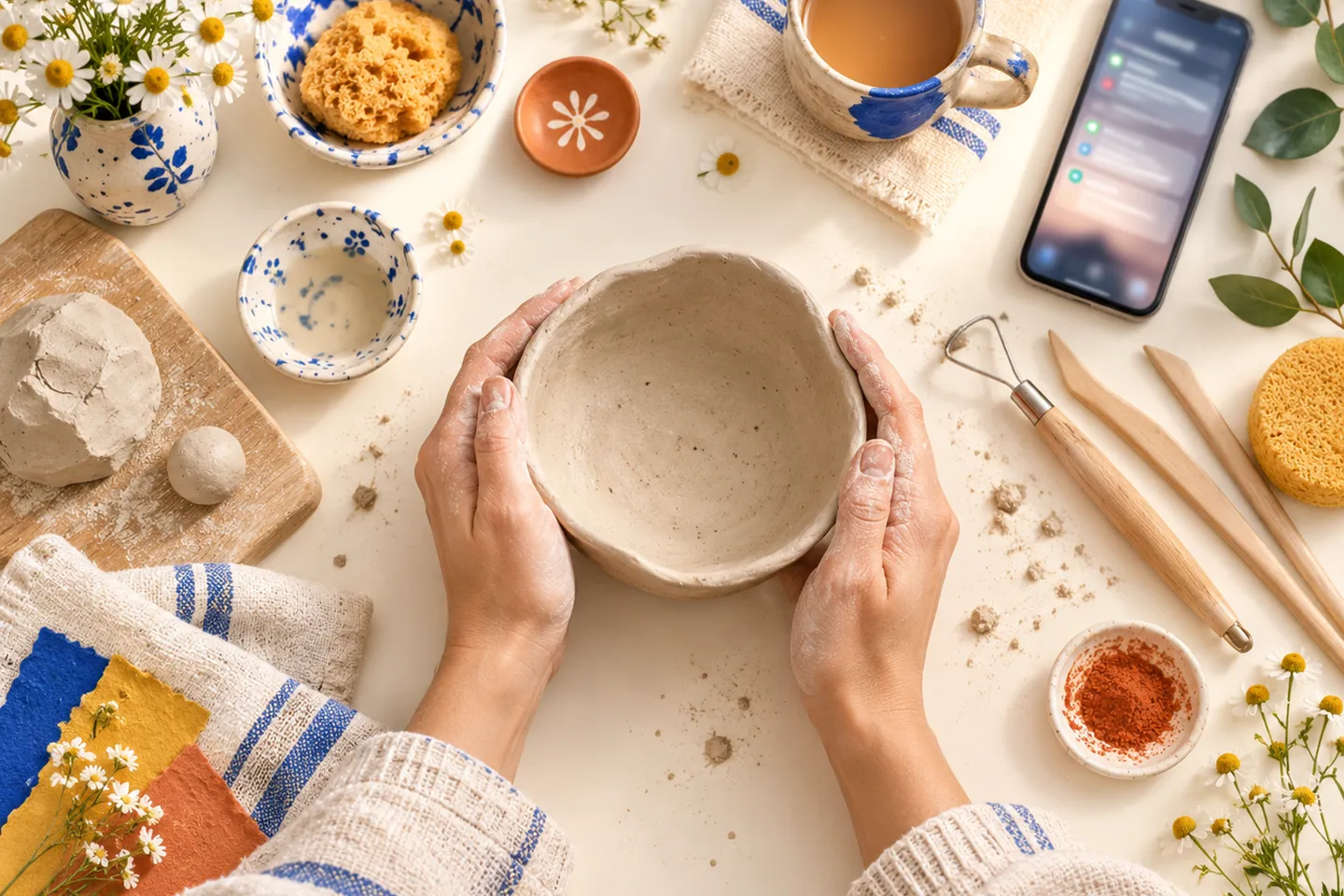
Make a small bowl out of clay. It will be lopsided. The rim will not be even. It will take you an hour to make something a factory makes in a second.
But it is yours in a way that nothing you buy or generate can be. You know where the thumb slipped. You know where you almost gave up and did not. When you drink from it, you drink from a decision you made.
There is a name for this in psychology. When people build something themselves, even badly, they value it more than a better version made by someone else. Researchers called it the IKEA effect. Craftspeople have known it forever.
The effort is not in the way of the value. The effort is the value.
Patience is a muscle, and it is getting weak
Most of us have not waited for anything in years. Not for a song to download. Not for a photo to develop. Not for a letter to arrive. We have trained ourselves, one tap at a time, to expect everything now.
And then we wonder why we cannot sit through a slow film. Why we cannot read a whole book. Why we cannot stay with a hard conversation. Why a two-minute wait at a counter feels unbearable.
Patience is not a personality trait. It is a muscle. And like any muscle, it gets weak when you stop using it.
Craft is the gym for this muscle. Crochet does not have a fast setting. A watercolour wash dries when it dries. Clay needs to rest before you can trim it. You cannot rush any of it, and if you try, the material simply refuses.
So you learn to wait. Not the anxious kind of waiting where you check your phone. The quiet kind, where you watch the thing you are making and let it take the time it takes.
Every time you do this, the muscle gets a little stronger. And it does not stay in the workshop. It comes home with you.
Why craft makes you think better
Here is something people do not expect. Working with your hands makes you sharper, not softer.
When you make a thing, you are solving problems the whole time. Why is this stitch tighter than the last one? Why does the colour look muddy? Why does this fold not sit flat? There is no answer key. You have to look closely, form a guess, try it, and see.
That is critical thinking in its purest form. Notice. Guess. Test. Adjust. Repeat.
We do less and less of this now, because so many answers are one search away. And an answer you look up is not the same as an answer you figured out. The first one you forget by Tuesday. The second one changes how you see.
The old craftsman’s rule holds. Measure twice, cut once. It is not really about measuring. It is about slowing down enough to think before you act. That habit is worth more than any single thing you will ever make.
Making is a form of meditation
People spend money and time trying to learn how to sit still and quiet the mind. It is hard. The mind does not like being told to be quiet.
But give the mind something to do with the hands, something simple and repetitive and slightly demanding, and it goes quiet on its own.
Stitch, stitch, stitch. Stroke, stroke, stroke. Fold, turn, fold.
This is not an accident. Every meditation tradition in the world has some version of it. Monks rake gardens. Buddhists count breaths. Sufis spin. Repetition with attention is one of the oldest paths to stillness there is.
Craft gives you this without needing to believe anything. You do not have to sit in a special position. You do not have to clear your mind. You just have to keep looping the yarn, and after a while you notice the noise has stopped.
Mark Manson says something worth sitting with. The desire for a more positive experience is itself a negative experience. Trying to feel calm is exhausting. Getting absorbed in something real is not. Making is absorption you can hold in your hands.
What machines cannot do for you
An AI can make a picture of a bowl. It cannot make your hands steadier. It cannot teach you to wait. It cannot give you the small private pride of having finished something slow. It cannot sit you at a table with strangers and let the conversation wander while everyone’s hands stay busy.
These are not features you can add later. They only come from doing the thing yourself.
We are not against the tools. Use them for what they are good at. But do not let them do the parts that were making you a person.
A small experiment
This week, make one thing slowly. It does not matter what.
Draw your coffee cup. Sew a button back on. Fold ten paper cranes. Make one bad, honest, lopsided bowl.
While you do it, notice the urge to hurry. Notice the voice that says this is pointless, someone could do it better, a machine could do it faster. Let the voice talk. Keep going.
At the end, hold the thing. It took time. That is exactly why it is worth something.
Slow hands in a fast world are not a step backwards. They are how you stay yourself.