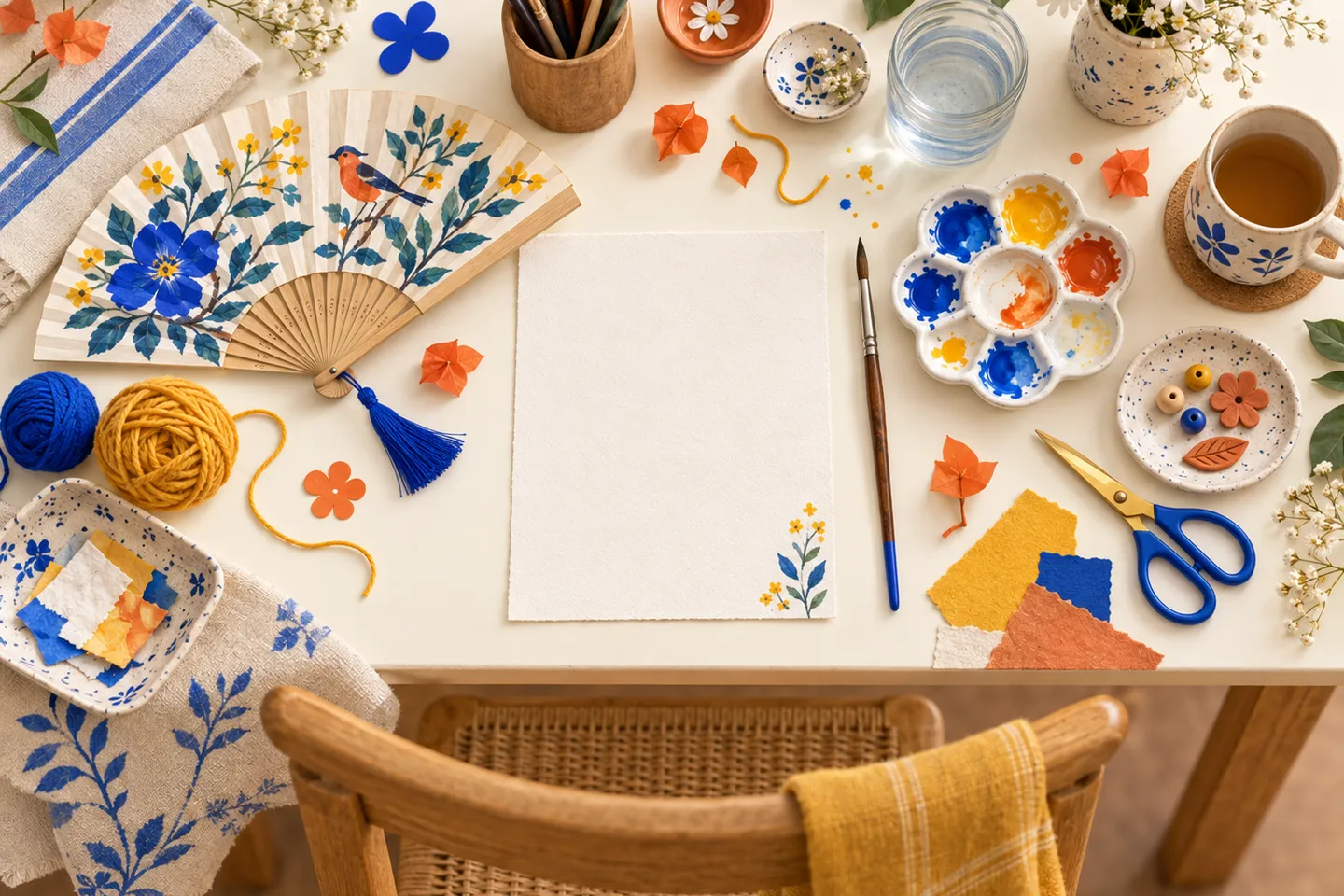
Most people who book their first workshop feel the same thing on the drive over. A small knot in the stomach. What if I am the only one who cannot do this? What if everyone else is secretly an artist?
Nobody is. The person next to you is thinking exactly the same thing.
Here is everything that happens, in order, so you can stop wondering and start looking forward to it.
Before you book: how to choose
We run three beginner workshops for adults. Each one is three hours. Each one includes your art kit. Each one is designed for people who have never done it before.
If you like pattern and want to walk out with something you can use, choose painting a paper fan. You fold, paint, and assemble a real folding fan. It is the most playful of the three, and a good choice if you want quick wins.
If colour is what pulls at you, choose acrylic painting. You get a canvas, a palette of acrylics, and a guided introduction to mixing and composition. This is the one for people who have had “I want to paint” sitting on a list for years.
If you want something slow, rhythmic, and calming, choose beginner crochet. You learn to hold the hook, make a chain, and work basic stitches into a small piece you finish in one sitting. You take the hook and yarn home, so this is the one that most easily becomes a habit.
There is no ranking. There is no beginner one and advanced one. The best starting point is the one you are curious about. Curiosity is the only preparation that matters.
Still stuck? Ask yourself which one you would be most disappointed to leave without. Book that.
What to bring
Almost nothing. Gubbi provides your art kit and all workshop materials. Canvas, paints, brushes, paper, hook, yarn, everything.
Bring yourself, on time. Wear clothes you do not mind getting a little messy. Acrylic paint does not wash out easily, so this is not the afternoon for your favourite white shirt.
Bring a water bottle if you like. Bring reading glasses if you use them. Crochet in particular rewards being able to see the stitches.
Do not bring your own supplies. Do not practise in advance. Do not watch tutorials the night before. Arriving with no idea is the whole point. We would rather teach you from zero than un-teach you a habit from a video.
What actually happens in three hours
The first twenty minutes are for settling. You find your seat, meet your materials, and we talk through what the afternoon looks like. Nobody makes anything yet. If you are nervous, this is where it wears off.
The first hour is guided. We show you the basic moves. How to hold the brush, how to load it, how to mix a colour. How to hold the hook, how to make a chain, how the yarn should sit in your hand. You follow along. Everyone is slow. Everyone is wobbly. That is what the first hour is for.
The middle hour is where it becomes yours. You have the basics, and now you use them on your own piece. We walk around, help when you are stuck, and leave you alone when you are in a rhythm. This is the hour people remember. The room goes quiet. Shoulders drop. Someone always says “I haven’t looked at my phone once.”
The last forty minutes are for finishing and looking. You complete your fan, your canvas, your small crochet piece. We take a moment to see what everyone made. Not a critique. Just a look. Then you take yours home.
You do not have to stay for the whole thing if you cannot. But almost everyone does.
Can I come by myself?
Yes, and many people do. Roughly half the people at any table came alone.
You can sit quietly and focus. You can chat while your hands are busy. You can move between the two as the afternoon goes on. There is no requirement to be outgoing, and no pressure to make friends. Though people often do, because it is hard to stay strangers when you have both just spent an hour fighting the same stitch.
If you want to bring a friend, a partner, or a parent, bring them. Just book two places.
What if mine looks different from everyone else’s?
It should. That is what success looks like.
We teach techniques, not templates. Guidance gives you tools. It does not require you to make a copy of the person beside you, or of anything we show you. If your fan ends up in colours nobody expected, good. If your canvas goes somewhere you did not plan, follow it.
You can ask for help as many times as you want. You can change direction halfway. You can keep an accidental mark because you like it. The only thing we ask is that you do not apologise for your work. Nobody at our table has ever needed to.
What if I am really, truly bad at this?
You will not be good at it. You have never done it. That is not the same as being bad.
Here is what we have noticed across hundreds of first-timers. The people who say “I cannot even draw a straight line” are not worse at this than anyone else. They are just more honest about being beginners. And they usually have the best afternoon, because they arrived with nothing to protect.
The work of the first workshop is not to make something good. It is to find out that you can sit with a material for three hours and enjoy it. Everything else comes after.
Where and how much
Workshops happen at OORKATHE in Bengaluru. Check the venue on Google Maps before you set off, and confirm your session time with us after you register.
Prices start at ₹1,299 per person, and include the full art kit and everything you make. There is nothing extra to buy on the day.
The only thing you need to decide
You do not have to decide what kind of artist you are before you arrive. You do not have to decide whether this will become a hobby. You do not have to decide anything except which afternoon.
Three hours is enough time to begin. That is all a first workshop is. A beginning.